

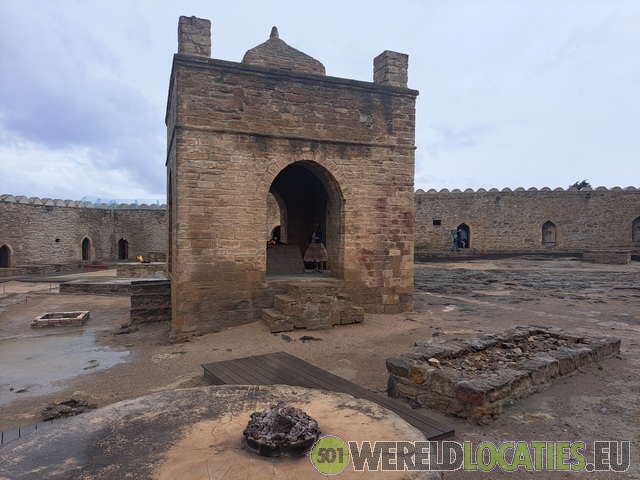


Foto: The dome survived the atomic bombing (bron: Ronald van der Veer)
Japan - At half past five, we leave Hotel Quel. After some deliberation, we decided to just drive into Hiroshima by car. The alternative of taking a train seemed difficult to manage at such an early hour—especially when you're unsure where to go or where to buy tickets. At this hour, the traffic isn't too bad. Within three-quarters of an hour, we reach downtown Hiroshima. We’re able to get reasonably close to the Peace Park where the ceremony is being held. Parking is more challenging. We drive into a parking lot, only to find it's reserved for the police today. Eventually, we opt for a paid parking area. From the sign, we gather it’s 100 yen per 10 minutes—over five euros per hour. Knowing we’ll be paying more than twenty euros later, we leave Brutus behind. The motorcycles are there too—they managed to sneak around the barrier. At least we’re close to the memorial park. Under the trees in the park, we find a spot with a good view. Luckily, the Japanese are not very tall. It’s already very warm. Under the tents for invited guests, a cooling mist is sprayed—but not for us. At eight o’clock, the Prime Minister arrives with a police escort, and the ceremony begins. At exactly 8:15, the time the bomb was dropped, one minute of silence is observed for the 140,000 victims. Silence? The crowd is silent, but during the minute, the loud sound of the Peace Bell rings out. Afterward, a thousand doves are released. After the ceremony, we can walk past the Peace Memorial. When someone hears I’m from the Netherlands, they hand me a flower to place at the monument. An impressive number of people are waiting to walk past the monument. Even more striking is how organized everything is. About fifty people are allowed through at a time. Volunteers lift a rope. No one pushes. Everyone waits their turn. Also, despite the thousands of people, the grounds are remarkably clean after the ceremony. There’s practically nothing on the ground. There are no trash bins. Everyone takes their trash with them. Three girls ask if I have a moment. They want to ask a few questions to practice their English. They’re amazed we came all the way from the Netherlands by car. They abandon English and continue writing in Japanese. They give me a drawing of a paper-folded crane. After the atomic bombing, a girl believed she would recover from cancer if she folded more than a thousand paper cranes. She passed away, but the crane still symbolizes the many youthful victims.


Buddhist Sensoji Temple

Japan - We leave the park to have a beer at its edge. It’s warm again today. There are a few light clouds. Rain is predicted during the night, which might bring some cooling. For now, we seek some relief along the Sumida River. The Senso-ji Temple is located ...
Ginza and Shibuya district in Tokyo

Japan - This afternoon, everyone does their own thing. I enjoy walking through the city alone for a while. Just some quiet around me. I walk from the bustle of Ginza toward the south. It’s obvious how well-organized everything in Japan is. At construction sites, ...
 Himeji Castle
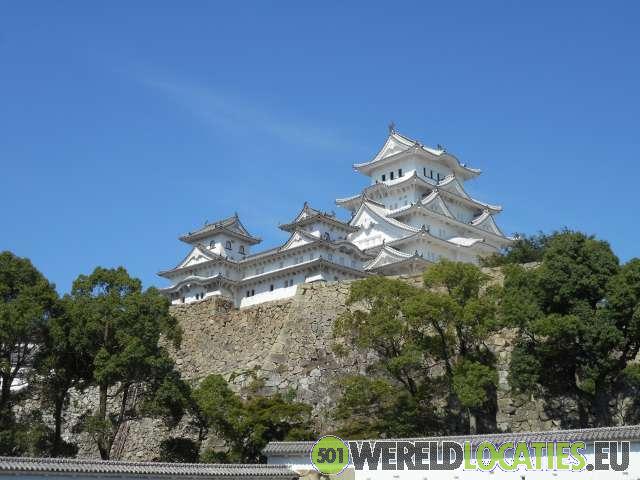
Japan - We drive to Himeji via the toll road. Himeji is home to the largest surviving feudal castle. The castle tower is especially impressive. From the outside it appears to have five floors, but inside there are six levels. This was intended to mislead attackers. ...
The center of Osaka

Japan - After just half an hour, the train pulls into Osaka station. My hostel is within walking distance, but I can’t get my bearings to figure out which direction to go. A kind lady at the information desk draws it out for me on a map. Hostel HIVE is located ...
The Itsukushima Shrine near Hatsukaichi

Japan - The heat and lack of sleep are taking their toll. I go in search of a toilet. Again, there are girls who want to practice their English. Fortunately, they’re also happy to show me where the toilet is. On the way, they ask me a few questions. I don’t ...
The temples of Kyoto

Japan - The Toji Temple is one of the oldest temples in Kyoto and, at 55 meters high, it boasts the tallest pagoda in Japan. The pagoda is the symbol of the city of Kyoto. Unfortunately, we can’t view the pagoda from the inside. It is only open during special ...